Every parent knows the scene: it’s 5:47pm, you’re making dinner, something is bubbling over, and your four-year-old is standing against your leg repeating “mum, mum, mum” like a broken smoke alarm.
So you hand over the tablet. Just until the pasta’s done.
And then forty minutes go by, the pasta is cold, the child hasn’t blinked in a while, and when you finally take the tablet away the meltdown takes down the whole hallway. You stand there with a cold plate thinking: we did this yesterday. We’ll do it tomorrow.
Yeah. I know. I’ve been there repeatedly. (The pasta incident is real. It was carbonara. I don’t want to talk about it.)
Here’s what eventually changed things for us: we stopped treating quiet time as something that happens to a child and started treating it as a skill, like pencil grip or putting shoes on the correct feet. You build it with the right tools at the right moment, in stupidly small doses.
These five tricks are what survived contact with real life — at home, in restaurants, in the back seat of the car. None of them need a screen, and none of them need you to be the entertainer.
Quick links (because I know you’re reading this one-handed while stirring something):
- The quiet time basket — yes, rotation again
- Match the book to the age — not the ambition
- Colouring as a calm-down tool — not a reward
- The go-bag — for restaurants, waiting rooms, the back seat
- Start stupidly small — then stop while it’s still fun
1. The Quiet Time Basket (Yes, It’s the Rotation Thing Again)
If you’ve read my post about flying with a toddler, you already know about the envelope trick. Same principle, different location.
A basket. Wicker, a shoebox, an empty delivery box turned on its side — the container doesn’t matter. What matters is what’s inside, and more importantly what isn’t. Ours is blue. This is not relevant information. It’s just blue.
The basket holds four or five quiet activities. Not all the activities, not the good toys — four or five. And the contents rotate once a week. Anything the child hasn’t seen in seven days counts as new again, and toddlers only care about new stuff, so the weekly rotation is basically the whole trick.
Ours usually contains:
- a colouring book and chunky crayons (triangular ones, because the round ones roll under the sofa and the sofa has suffered enough)
- a tracing book if it’s a tracing week — our tracing book for 3-4 year olds lives in there more often than I’d like to admit
- a couple of small board books
- a soft rabbit called Biscuit, who “also wants quiet time.” Biscuit went through the dishwasher once in 2024 and still faintly rattles if you shake him. The child loves him more for it. I have stopped asking questions.
What never goes in: anything with batteries, anything with tiny parts, anything that sings.
The basket lives on a low shelf and the child is allowed to grab it any time. That’s the sneaky part. When quiet time is always available instead of imposed, it stops being a punishment. Kids choose it surprisingly often. On good days.
2. Match the Book to the Age, Not the Ambition
The most common quiet-time failure I hear about goes like this: a parent buys an activity book “to grow into,” the child can’t do it, gets frustrated, flings it across the room, and the parent concludes that activity books “don’t work on him.”
The book wasn’t the problem. The age label was. A two-year-old handed a word search will not quietly search for words. A two-year-old handed a word search will eat the pencil, and honestly? Fair. The book was never for them.
A rough guide, from watching my own kids and from making these books for a living:
- 1 to 3: big, thick-line colouring, one animal per page, lines you can see from space. We make two “first” colouring books — the farm one and the animals one — and either does the job. Success is guaranteed, which is what makes a child want page two.
- 3 to 5: tracing and simple shapes. Our tracing shapes book for ages 3-5 is the sweet spot here — it feels like drawing and it’s secretly pre-writing practice.
- 5 to 7: mazes, spotting differences, simple counting, and eventually a first word search for ages 5-7. That’s usually the first “big kid” book that actually lands, and the day your child spells out a word they found themselves is a genuinely good day.
- 8 and up: sudoku. Just… sudoku. That’s the whole age bracket. (We make a kids' sudoku for ages 8-12 if you want a starting point, but honestly any sudoku will do.)
If they finish a page in two minutes and look proud, the book was right. If they scribble over the whole thing and look proud, also right. What matters is the pride, not the neatness. I keep wanting to correct my daughter’s colour choices and I keep having to remember that nobody has ever appointed me art director.
3. Stop Treating Colouring as a Reward. It’s a Calm-Down Tool.
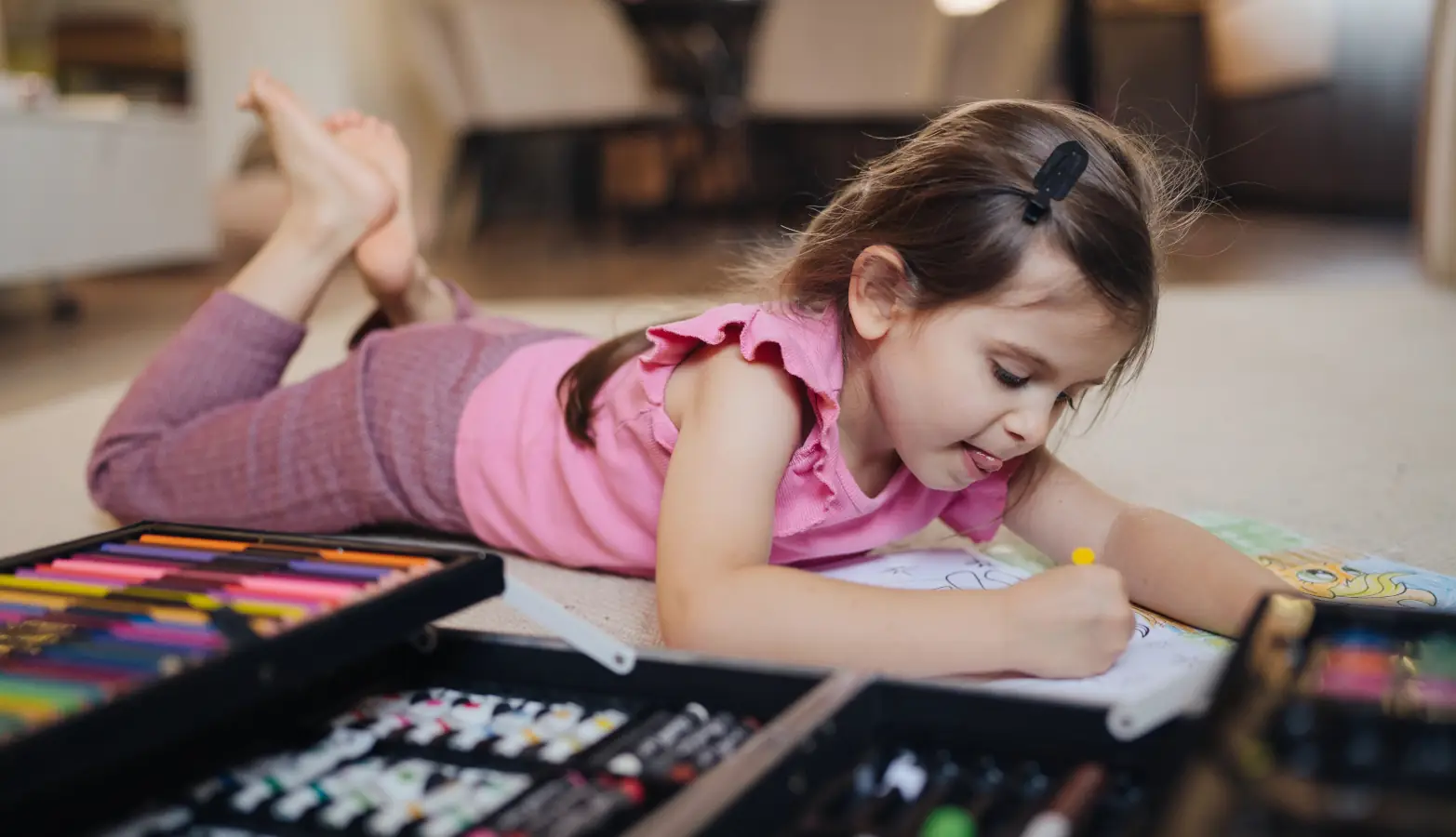
Somewhere along the way, colouring got demoted to “the thing they do when there’s nothing else to do.” Which is a shame, because it’s one of the few activities that genuinely slows a child down — repetitive, low-stakes, rhythmic. It works a bit the way a long walk works for us.
The best moment to offer it is not when your child is already calm. It’s right after the storm: after the meltdown, after the too-loud birthday party, after a nursery day that was apparently full political theatre. (It always is.)
Don’t announce it. Don’t say “why don’t you calm down with some colouring,” because that sentence has never calmed anyone in the history of the planet. Instead, sit down at the table yourself with a colouring page and start colouring. Badly. Enthusiastically. Small children cannot resist an adult doing something pointless with concentration. They will come over. They will demand the blue pencil. You hand it over, and twenty minutes later the house is quiet and you’re both a bit calmer and nobody had to be taught anything.
Wait, one correction — this only works if you actually put your phone away first. I tried it once while “just answering one email” and my daughter said, and I quote, “you’re doing a screen.” Fair. The rules apply to me too, apparently.
For this trick I’d pick gentle subjects. Our sea creatures colouring book is the one we reach for — slow animals, big shapes, nothing that invites battle sound effects. Save the dinosaur fights for high-energy mornings.
4. Build a Go-Bag for the Real World (Restaurants, Waiting Rooms, the Back Seat)
Quiet time at home is easy mode. The real world is harder: a restaurant table the size of a notebook, a waiting room with a glass coffee table they’re not allowed to touch, a car ride that goes on so long that everyone forgets what day it is.
The go-bag lives by the door. Ours is a boring canvas tote, and inside it there’s:
- one square-format activity book. Square matters — I learned this on a plane and I’ve written about it before. A big rectangular book doesn’t fit on a restaurant placemat; a square one does. If your kid is in a vehicles phase, the vehicles activity book; if your house runs on dinosaur fuel like ours, the dinosaur activity book for 5-6 year olds.
- a pencil case with six crayons and one pencil. Six, not forty, because forty crayons at a restaurant table means forty decisions, and decisions at that age are expensive.
- wipes. Always. The table was sticky before you arrived and it will be stickier after.
- one small “emergency” activity sealed in an envelope, to be opened only when the food is delayed. The envelope is most of the value. Sealed things are treasure.
And one rule for the car: the go-bag rides in the front seat, not with the child. You pass items back one at a time. A child with access to the whole bag will hand every single item back within four minutes, rejected, then cry that there’s “nothing to do.” I don’t know why this is true. It is true.
I keep meaning to add a spare shirt to the bag and I keep forgetting, and every single time I forget there is a yogurt incident. I’m writing this down here so I finally do something about it.
5. Start Stupidly Small. Then Stop While It’s Still Fun.
Here’s the number I wish someone had told me years ago: a three-year-old’s attention span is about five minutes. A five-year-old gives you maybe ten to fifteen on a good day.
So don’t aim for “an hour of quiet time.” Aim for five minutes.
Day one: the basket appears, the child investigates, three minutes of colouring happen, you declare victory. Day two, maybe four minutes. By week two you’re getting ten, sometimes fifteen, and — here’s the part nobody tells you — the child starts asking for it. Quiet time stops being a battle and becomes part of the shape of the day, like bath time.
And the golden rule, the same one I wrote about in my pencil grip post: stop while they’re still enjoying it. If page three is going great, close the book at page three. Tomorrow they’ll come back wanting more. I keep repeating “motivation compounds, so does resentment” because it’s the truest sentence I’ve ever written about parenting, and I will keep repeating it until it lands.
A timer helps, if your kid responds to one — actually, scratch that. Some kids hate timers and will fight you on principle. Know your child. Ours is a timer child. Yours might be… not. The idea was that the timer becomes the bad guy instead of you, but if your kid treats a kitchen timer as a personal insult, skip it. You know your kid. I barely know mine.
The Bottom Line
You don’t need a screen-free parenting course or a £60 “calm corner” furniture set from Instagram. They photograph beautifully, and your child will use one as a fort within the week, which is also fine — but it’s not required.
You need a basket. A few books that actually match the age. A tote by the door. And the willingness to start with five minutes and call it a win.
The tablet will still happen sometimes. Of course it will. You’re a parent, not a monk. The goal isn’t zero screens forever. The goal is that quiet time without a screen exists as an option your child doesn’t hate. That’s the whole goal. (And if you need a starting point for that basket…)
All the books mentioned above are ones we make and genuinely use at our own table. Browse the full activity books collection or peek at the colouring books — square formats, thick lines, and nothing tiny to lose under the sofa.
Stuff People Keep Emailing Me About
How do I do quiet time with two kids of different ages?
Separate baskets. Seriously. The moment the younger one can reach the older one’s stuff, it’s not an activity anymore, it’s a conflict. The older kid gets a “big kid” book and the privilege of sitting in a different chair. The different chair matters more than the book.
My kid will only colour for two minutes. Is it not working?
Two minutes at the start is it working. You’re not building a colouring session, you’re building a habit, and habits start small. Two minutes today, four next week. It adds up, slowly, like everything else with children.
Is quiet time the same as nap time?
No. Nap time is sleep; quiet time is low-key awake time. For kids who’ve dropped their nap, quiet time is the replacement — same slot, roughly the same length, no sleeping required. Everybody rests, nobody sleeps, the house is quiet, and the parent stares at a wall for forty minutes. It’s glorious.
Can the basket be plastic? Or a cardboard box?
Yes. It can be plastic. It can be a cardboard box. I don’t care. The container is not the point. (Ours is still blue, for the record.)
Do the crayons need to be a specific brand?
Someone asked me this and I nearly cried. No. Any crayons. Please. The only thing I’d actually insist on is the triangular shape for the little ones — and that’s not a brand thing, that’s geometry.