Christmas with a toddler is mostly logistics. The lights are lovely until they’re too much, the visiting is lovely until someone hands over a singing reindeer at bedtime, and the activity you set up so carefully lasts about ninety seconds.
This is a slower plan: short, low-prep things to do across December with a one-, two- or almost-three-year-old, whether it’s your first Christmas with a toddler or your third. One at a time, mostly on the floor, with you close by.
Why Toddlers Need a Gentler Christmas
You can see the limit arriving: the louder voice and the sudden urgent need to be outside. A room full of paper, cousins and music is a lot for someone who has been alive for eighteen months.
Keeping the day low-stimulation helps. So does remembering that busy and settled are different states. A toddler can be thoroughly occupied and still be wound up tight. What tends to work in December is slow and repetitive: squashing and posting.
The photos matter to you more than to them.
The 10-Minute Rule (and Other Ground Rules)
Ten minutes is a rough guide: long enough to get somewhere, short enough to stop before things unravel.
One planned activity a day. The December box, the window star and the tree lights are background.
Sit down with them, on the floor or at a low table. Left alone with a tray, most of this lasts a minute or two.
Stop while it’s still going well. Two happy minutes beat eight that end in tears.
Don’t coax. If they walk off, that’s the end of it.
Quiet Advent: One Tiny Tradition a Week
A chocolate calendar is wasted on a child who can’t count to four. One small thing a week does the job.
Week one: the December box
A shoebox with a large wooden star and a bell with its clapper securely enclosed, both bigger than a toilet-roll tube. Nothing loose or detachable. It comes out for a few minutes a day, then goes back up high. Stay close while they explore it.
Week two: one star in the window
Cut a single star and stick it up at their height. Every evening you point at it and say the same thing.
Week three: a tree they can touch
One large, soft fabric ornament (felt or cloth), with no hook, string, loop, buttons or beads. Keep it in a basket beside the tree, or let them place it on a low, stable branch while you’re there. They move it, you move it back. Anchor the tree to the wall, and keep cables and breakable baubles out of reach.
Week four: a countdown without chocolate
Four paper stars for the last four days, stuck up together each evening. When your toddler turns three and starts counting properly, there’s a free three-day sample of our 24-day Christmas countdown for 3–4 year olds to move on to.
12 Gentle Christmas Activities for Ages 1–3
Twelve low-prep ideas, from sensory play to simple crafts. Prep times are estimates; mess is what lands on the floor.
For a one-year-old, the easiest starts are 11 and 12. Honestly, a one-year-old needs less than this list: tree lights, a board book, and a spoon and bowl to bang are plenty.
Activities 3, 7 and 9 use loose paper, so save them until your child has stopped putting non-food things in their mouth. For many children, that’s closer to two or later. Most two-year-olds can try the activities on this list, though stickers may need a hand. The ages are rough starting points: if something looks too fiddly or too mouthable, skip it.
| Activity | Age | Prep | Mess |
|---|---|---|---|
| 1. Christmas dough | 2y+ | 2 min | Medium |
| 2. Squish bag | 18m+ | 2 min | Low |
| 3. Paper snow | 2y+* | None | Medium |
| 4. Tube stamping | 18m+ | 2 min | Medium |
| 5. Paint-blob snowman | 18m+ | 1 min | Medium |
| 6. Sticker tree | 2y+ | 1 min | Low |
| 7. Wrap and unwrap | 2y+* | 3 min | Low |
| 8. Red and green sorting | 18m+ | 1 min | None |
| 9. Card box | 2y+* | 5 min | None |
| 10. Loud and quiet carols | 18m+ | None | None |
| 11. Bang and freeze | 12m+ | None | None |
| 12. Tree lights | Any | None | None |
*Paper activities involving loose paper pieces or cards are only suitable for toddlers who no longer put non-food objects in their mouths. Stay within arm’s reach.
A few ground rules for all of them. Stay close, because at this age some of everything gets tasted. Use non-toxic, washable paints. As a rough check, keep anything that fits inside a toilet-roll tube away from your child. The tube is wider than the official small-parts tester, so it’s a cautious guide, not a guarantee: parts can also break off, so check things by hand too.
1. Christmas dough with one spice (2 years+)
Use a commercially made play dough labelled for your child’s age; most tubs are marked 2+. Knead in a teaspoon of cinnamon yourself, away from the child, so the powder isn’t in the air. Homemade salt dough is a poor choice here: raw flour can carry E. coli or Salmonella, and the salt makes it dangerous if swallowed. Play dough is not food. If a good amount gets eaten, call your doctor or pharmacist.
You need: ready-made dough, cinnamon.
Survival version: plain dough, no spice.
2. The sealed squish bag (18 months+)
Real baubles and small hands don’t mix. Put the feel of them in a bag instead. The simplest option is a ready-made sensory bag or mat labelled as suitable for your child’s age. Some are marked 3+, so check the packaging and wait if yours is. To make your own, use unscented clear gel sold for children’s crafts or sensory play, with nothing floating in it. Bag it twice, press the air out and tape all four edges to the floor. Watch it the whole time and throw it out at the first leak.
You need: a ready-made toddler sensory bag, or two strong zip bags, clear gel and tape.
Survival version: hold the bag yourself the whole time instead of taping it down. It isn’t for solo play.
3. A bowl of paper snow (2 years+*)
Tearing paper is oddly absorbing at this age. Use large pieces of clean paper without staples, a bowl and a cup for pouring. Show one tear, then leave them to it. The snow ends up on the floor.
4. Baubles stamped with a cardboard tube (18 months+)
Dip the end of a cardboard tube in washable paint and stamp circles down a sheet of paper. Add strings afterwards and it looks like a box of decorations. One colour is enough; several turn the sheet brown.
You need: a cardboard tube, paint in a saucer, paper.
Survival version: one stamp, one sheet.
5. A paint-blob snowman (18 months+)
White washable paint, dark paper, three big blobs in a row. You add the eyes and nose later, once they’ve wandered off. Two minutes, and you get something for the wall.
You need: white paint, dark paper, wipes.
Survival version: one blob.
6. Stickers on a paper tree (2 years+)
Draw a big triangle and hand over a strip of large stickers. They will put them on the table and their sleeve before the tree. Peeling and pressing is the point. Stay beside them, and stop when stickers head for mouths.
7. Wrap it, open it, wrap it again (2 years+*)
Wrap three of their own toys (nothing with small parts) in leftover paper, with one short piece of tape on each parcel, put on by you. Keep the tape roll out of reach. Let them tear the parcels open, clear away scraps as you go, and wrap them again until the paper gives up. Skip ribbon and string.
You need: paper, tape, three familiar toys.
Survival version: one toy under a sheet of paper.
8. Red pile, green pile (18 months+)
Two bowls and six to eight red and green things: large, solid blocks or oversized fabric items with no parts that come off. Show one, name the colour, drop it in. They may sort them, or just move everything between bowls. Don’t correct either.
You need: two bowls, big blocks or fabric items in two colours.
Survival version: one bowl, one colour.
9. A card box with a slot (2 years+*)
Cut a slot in a shoebox lid, tape the cut edge so it isn’t sharp, fix the lid down and hand over old cards. Skip musical and glitter cards; musical ones can hide button batteries. They post, you empty, it starts again.
You need: a shoebox, scissors (yours), plain cards.
Survival version: an open box.
10. Loud carols, quiet carols (18 months+)
Play a carol, or sing one. Hands up high means loud, hands down low means whisper. The whisper verse often gets the laugh, and the volume signal brings things down before they tip over.
You need: a speaker or your own voice.
Survival version: one verse, whispered.
11. Bang, then freeze (12 months+)
A wooden spoon and an upturned plastic bowl, or a pan with a folded cloth over the top, so the bang is a thud rather than a clang. Music on: bang. Music off: freeze. If they ignore the freezing, let them bang. Hopeless at bedtime.
You need: a spoon, a plastic bowl, music.
Survival version: one round.
12. Tree lights, from the floor (any age)
Main lights off, tree lights on, both of you on the floor looking at them. Nothing to set up or clear away, and it doesn’t count towards your one a day. If yours are battery-powered, check the pack is screwed shut and out of reach.
First Colouring at 1–3
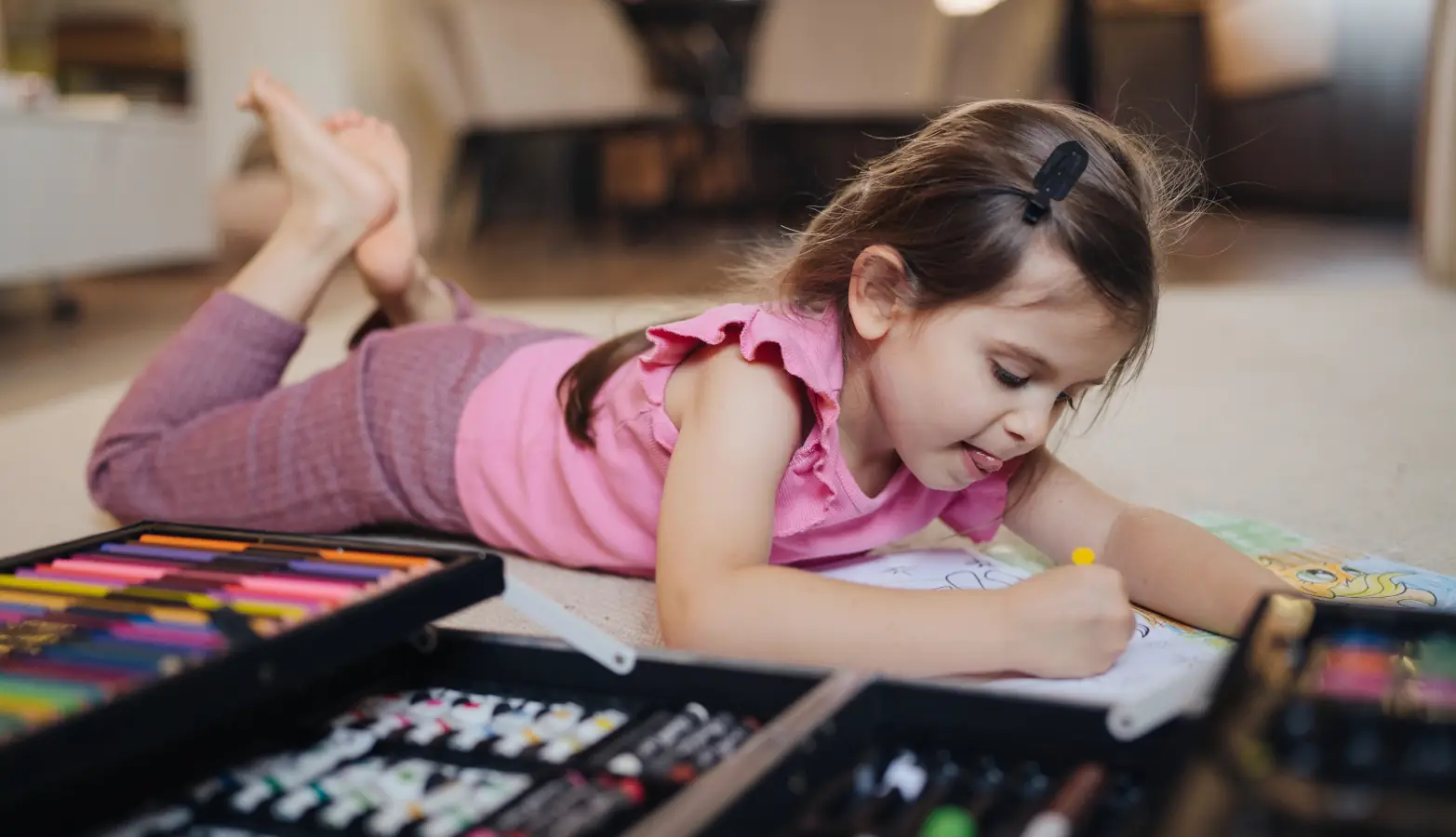
Somewhere between one and two, most children start making marks, and that is the whole of it.
What helps: chunky crayons they can hold in a fist, one big shape per page, thick outlines, plenty of white space. A square page fits on a high chair tray; tape it down.
Choose large crayons labelled as suitable for your child’s age. Stay within arm’s reach, remove broken pieces straight away, and remember that non-toxic does not mean edible.
Don’t ask what it is, or mention that the snowman is green. Two minutes of scribble is a finished session.
This is the book we made to those rules:
My First Christmas Colouring Book for 1-3 Year Olds
Thick lines and one large shape per page: Santa, a reindeer, a snowman. Square, 8.5 × 8.5 inches (21.6 cm), about as wide as an A4 sheet but much shorter.
Prefer to try first? Download free sample pages — no email needed. Six big-line pages print at home tonight, on any printer.
Download free sample pages →
Screen Time at Christmas
We make screen-free books, so weigh this accordingly: for an older toddler, a cartoon at five o’clock so that dinner happens is a plan, not a failure. The American Academy of Pediatrics' 2026 policy on children and digital media looks beyond screen-time totals, taking into account the quality of content, the context and whether an adult watches alongside the child. Earlier AAP guidance advised avoiding screen media before 18 months apart from video calls. Under 18 months, the realistic version is a video call with grandparents. If you do put a cartoon on, keep it short and sit nearby, then switch off and go back to the floor.
When There’s Family Around
A lot of the difficulty is other people’s expectations, and one sentence beforehand fixes a surprising amount of it: one present at a time, and we’re heading home by seven.
If you’re hosting, set up a single room where everything in reach is allowed, so you’re not spending the afternoon saying no and the toddler has somewhere to go when the noise builds.
Give the toddler a job. Handing out napkins works well: it keeps them moving and gives them a reason to be in the room other than being passed from aunt to aunt. If someone has brought the loudest toy in the house, ask them to take the batteries out until later and put them somewhere high and out of reach. Know which bedroom you can disappear into for ten quiet minutes.
If older cousins are coming, give them their own table and something to do there. Our Christmas activity books are made for that.
A Simple Christmas Day Schedule
Here’s an example. Adapt it to your day.
- Early: one present, opened slowly, over a hot coffee.
- Mid-morning: outside. Cold air often does more than any activity on this list.
- Before lunch: the one planned activity.
- Nap: protect it. If the nap goes, the afternoon goes with it.
- Late afternoon: a second activity only if they ask for one.
- Evening: tree lights from the floor, one book, bed at the usual time.
On a visiting day, the lunchtime activity becomes the visit. Keep two or three activities in rotation across the week. Pack a sheet of paper and a chunky crayon for the journey, plus a few single-sheet free printable pages for any older siblings.
Frequently Asked Questions
How many of these activities can a 2-year-old do in one day?
One planned activity is a good day. A second, if they ask, is fine. Repeating is fine too: the same dough three days running is three good days. Looking at the tree lights doesn’t use up your one.
When can a toddler start using colouring books?
Usually between one and two, with chunky crayons and one big shape per page. Many books sold as a Christmas coloring book for toddlers are really for older children: too many lines, too much detail. Look for thick outlines, big shapes and plenty of white space.
Is it OK to skip all the crafts and just keep Christmas low-key?
Yes. Walks, lights and one book will do. Nothing here is a requirement, and plenty of children have a lovely Christmas with no crafts.
What’s a good Christmas gift for a 1-year-old?
Most one-year-olds are happiest with things they can carry and bang, like nesting cups, a ball or a board book. A first colouring book with chunky crayons labelled for your child’s age is a good alternative. Stay close: non-toxic does not mean edible, and at this age some of the crayon gets tasted.
One last thing
None of this needs doing. If December turns out to be walks, dough and the same carol on repeat, that’s a good Christmas.
If you’d like three free books for the older ones (colouring, tracing and word searches, ages 3 and up), join the newsletter.